
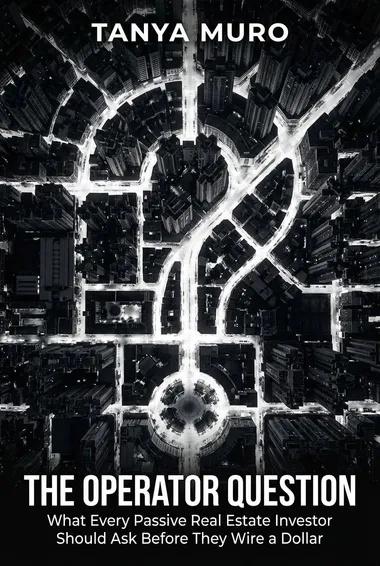
The Operator Question: Tanya Muro’s New Book for Passive Real Estate Investors
The confirmation email arrives at 2:47 in the afternoon. Your wire transfer has been received. Welcome to the offering.
That is how Tanya Muro’s new book, The Operator Question: What Every Passive Real Estate Investor Should Ask Before They Wire a Dollar, begins. The investor in that scene has done everything right by the usual standards. She read the offering summary. She reviewed her advisor’s due diligence report. She checked the fee structure and compared returns.
Then she closes her laptop and moves on. Meanwhile, decisions about her capital start being made by people she has never met, in a room she will never enter.
The book is about what happens in that room, and how to judge the people in it before you send them your money. It’s available now on Amazon.
What Is The Operator Question About?
Passive real estate investors are taught to evaluate the deal: the property, the market, the financing, the projected returns. Tanya argues that this is necessary but not sufficient, because the deal is not the investment.
“The operator is the investment.”
The deal is the surface. The investment is your relationship with the operator who controls your capital for the next five to ten years. That means their judgment, discipline, integrity and organizational capability. None of it shows up in a spreadsheet, and no offering document fully discloses it.
The book illustrates this with two sponsors who buy identical properties, in the same market, with the same financing, in the same month. Five years later one has beaten its projections and the other is in special servicing. The deal wasn’t different. The operator was.
Tanya’s conclusion: investors who lose capital in passive real estate almost never lose it because the structure failed. They lose it because the operator failed, and the signs were usually there before the investment was made.
Who Is the Book For?
It is written for accredited investors who put capital into Delaware Statutory Trusts (DSTs), real estate syndications and private placements. It is especially for experienced investors who have “done this before” and assume that means they know what they’re doing now.
The book is not a warning against passive real estate. Tanya is clear that the structures are sound and the asset class has built real wealth for decades. It is not suspicious of sponsors either. In her words, “Precision is not suspicion.” The best operators welcome precise questions because they have good answers.
What’s Inside: The Ten Chapters
The book follows four composite investors, Patricia, James, Susan and Robert, and David. Each illustrates a different way capital gets lost. The chapters build on one another:
- The Room You’re Not In. Why screening a deal is not the same as due diligence, and why due diligence continues for the life of the hold.
- What the Pitch Doesn’t Show You. How sponsor presentations are built to produce a feeling of confidence, and why the risk factors slide deserves more attention than the IRR.
- The Operator Behind the Offering. The question almost nobody asks: Who are you when things go wrong?
- The Track Record Trap. Why a track record slide is a selection, not a history. Covers IRR versus equity multiple, subscription credit lines and vintage-year arithmetic.
- What Happens When Things Go Wrong. The recognizable stages between the moment a deal stops working and the moment investors find out.
- The Communication Tells. How to read quarterly reports for the language that replaces information.
- The Fee Question Nobody Asks. Assembling your true, all-in fee load instead of accepting the stated one.
- The Questions That Reveal Character. Twelve questions that show who is running the deal, not just how it was underwritten.
- The Portfolio You’re Actually Building. Why three “diversified” investments can share one hidden risk.
- The Investor You Become. The complete due diligence framework, assembled.
The Five Dimensions of Operator Quality
A core idea of the book is that operator quality is a profile, not a single number. Tanya breaks it into five dimensions:
- Track record: the complete one, including the deals that underperformed and how investors were treated during them.
- Organizational depth: whether a real team and real processes exist, or a founder surrounded by titles.
- Alignment: whether the sponsor has enough of its own capital at risk to share meaningfully in the downside.
- Communication culture: how the sponsor communicates under pressure, not just in good quarters.
- Adversity response: what the sponsor actually did when conditions broke from the projections, such as the 2022–2025 rate cycle.
The Warning Signs Most Investors Miss
Some of the book’s most practical material is about reading the documents investors already receive.
The language shift. When a property performs, quarterly reports are specific, for example: occupancy at 94%, up two points from last quarter. When it doesn’t, the specifics retreat. Numbers become ranges, ranges become descriptions, and descriptions become reassurances like “the property continues to perform well in a competitive market environment.” In one of the book’s examples, an occupancy table simply disappears from a report. Five months later, distributions stop.
Response time. A sponsor who used to answer the same day and now takes a week is telling you something.
The fee assembly. Fees are disclosed, but they are scattered across a 240-page document and rarely added up. In one composite, a 12% stated front-end load turns out to be roughly 22% once every fee across the hold period is included. Tanya’s advice is to ask the sponsor to do that math for you before you sign, and to notice how willingly they do it.
A Few of the Twelve Questions
Chapter 8 is the heart of the book. Each question comes with what a good answer sounds like and what deflection looks like. Here are four of them:
- Tell me about the investment in your history that performed furthest below your original projections. What happened, and how did you communicate with investors during that period?
- If your lead asset manager left tomorrow, what would happen to this investment?
- What percentage of your personal capital is invested in this offering, and in what form?
- What is the one thing about this investment that keeps you up at night?
The book has all twelve, plus a reference card you can bring to sponsor meetings.
How to Read It
The chapters can be read in order or on their own. Tanya suggests:
- If you have an investment decision in front of you right now, start with Chapter 8.
- If you already have capital deployed and want to know whether to worry, start with Chapter 6.
- If you’re building a framework from scratch, read straight through to the appendix, which assembles everything into one due diligence system designed to be printed and used.
Why Tanya Muro Wrote It
Tanya has spent her career on both sides of this transaction. As an operator, she has received investor capital, structured acquisitions, managed assets, handled lender relationships, and made the hundreds of decisions that happen between the wire and the distribution check. As an investor, she has sat on the other side of the table and made the same comfortable assumptions experienced investors make.
Over a 25+ year career she has closed nearly $3 billion in real estate transactions, including the nation’s first tenant-in-common acquisition. She co-founded Academy West Investments with Blake Wettengel, led the firm’s investor-centric restructuring of its offerings in 2023, and is now Co-Founder and COO of Crew Enterprises. See more press and recognition. That operator’s perspective runs through the whole book, along with her long-held view that complexity kills deals.
She is also clear about what the book is not. Most sponsors in this market are doing what they say they are doing, and the framework is “not a prosecution of the industry.” It is a tool for finding the best of it. The goal is to help investors tell the operators who feel the weight of their capital from the ones who feel only the wire confirmation.
Get the Book
The Operator Question is available now in a Kindle edition on Amazon.
Questions
Frequently Asked Questions
Who is The Operator Question for?
It is written for accredited investors who put capital into Delaware Statutory Trusts (DSTs), real estate syndications and private placements, especially experienced investors who want to evaluate sponsors the way institutional investors do.
What does “the operator is the investment” mean?
The deal is the property, market, financing and projected returns. The investment is your relationship with the operator who controls your capital for the next five to ten years. Tanya Muro argues that investors rarely lose money because a structure failed; they lose it because the operator failed, and the signs were usually visible before they invested.
What are the twelve questions in the book?
Chapter 8 sets out twelve questions to ask a sponsor that reveal character rather than just competence. Examples include: tell me about the investment that performed furthest below your projections; what would happen if your lead asset manager left tomorrow; and what percentage of your personal capital is invested in this offering. The book explains what a good answer and a deflection sound like for each.
Where should I start reading?
If you have an investment decision in front of you now, start with Chapter 8. If you already have capital deployed and want to know whether to be concerned, start with Chapter 6. If you are building a framework from scratch, read straight through to the appendix, which assembles the complete due diligence framework.
Is the book a warning against passive real estate investing?
No. The book describes DSTs, syndications and private REITs as legitimate structures that have built real wealth. It is a framework for telling strong operators from weak ones, and it notes that most sponsors in the market are doing what they say they are doing.
Where can I buy The Operator Question?
The Operator Question is available as a Kindle edition on Amazon.